Learning how to read an astrocartography map opens up a world of possibilities for understanding how different locations can influence your life. This comprehensive guide will walk you through everything you need to know about interpreting your personalized astrocartography map, from understanding basic planetary lines to making practical decisions about where to live, work, and travel.
Quick Answer: What is an Astrocartography Map?
An astrocartography map projects your birth chart onto a world map, showing colored lines that represent where different planetary energies are strongest for you. These lines indicate locations where you might experience enhanced career opportunities (Sun/Jupiter lines), deeper relationships (Venus lines), emotional healing (Moon lines), or other life themes based on each planet's influence.
Understanding the Basics
Before you can master how to read astrocartography maps, you need to understand what you're looking at. An astrocartography map takes the positions of the planets at your exact moment of birth and projects these positions onto a geographical map of the world.
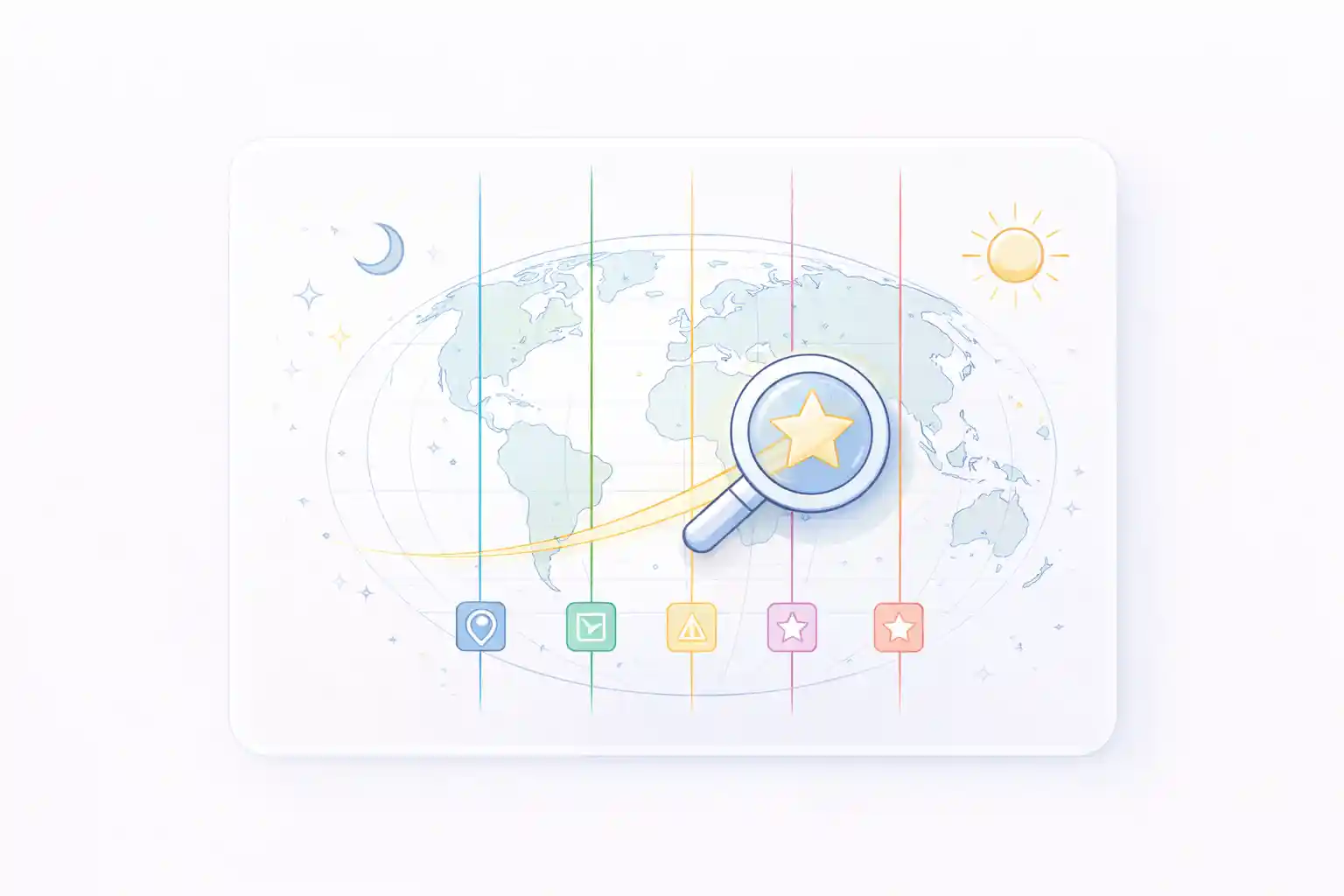
Key Components of Your Map
- Colored Lines: Each color represents a different planet
- Line Types: AC (Ascendant), DC (Descendant), MC (Midheaven), IC (Imum Coeli)
- Planetary Symbols: Indicate which planet each line represents
- Crossing Points: Where multiple lines intersect
Step-by-Step Guide to Reading Your Map
Step 1: Generate Your Astrocartography Map
To accurately read your astrocartography map, you first need to create one using your precise birth information:
- Birth Date: Day, month, and year of your birth
- Birth Time: As exact as possible (within 4 minutes ideally)
- Birth Location: City and country where you were born

Generate your map with our free tool
Step 2: Identify the Four Line Types
Every planet creates four lines on your astrocartography map, each with distinct meanings:
Ascendant (AC) Lines - Identity and Self-Expression
- Where the planet was rising at your birth time
- Affects how you present yourself and your personality
- Best for personal development and new beginnings
Descendant (DC) Lines - Relationships and Partnerships
- Where the planet was setting at your birth time
- Influences your partnerships and how others perceive you
- Ideal for romantic relationships and business partnerships
Midheaven (MC) Lines - Career and Public Life
- Where the planet was at its highest point
- Impacts your career, reputation, and public standing
- Perfect for professional advancement and recognition
Imum Coeli (IC) Lines - Home and Inner Life
- Where the planet was at its lowest point
- Relates to your home life, family, and emotional foundations
- Great for settling down and creating roots
Step 3: Learn the Planetary Meanings
Each planet brings specific energies when reading your astrocartography map:
| Planet | Energy | Best For |
|---|---|---|
| Sun | Identity, vitality, recognition | Career advancement, leadership |
| Moon | Emotions, intuition, nurturing | Family, emotional healing |
| Mercury | Communication, learning | Writing, teaching, business |
| Venus | Love, beauty, creativity | Romance, art, social connections |
| Mars | Action, ambition, energy | Starting ventures, physical activity |
| Jupiter | Expansion, luck, opportunity | Travel, education, spiritual growth |
| Saturn | Discipline, structure | Long-term achievements, stability |
Step 4: Understand Distance and Orbs
A crucial part of learning how to read astrocartography maps is understanding that you don't need to be directly on a line to feel its effects:
- Strongest influence: Within 100 miles (160 km) of the line
- Noticeable influence: Within 300-400 miles (500-650 km)
- Subtle influence: Up to 700 miles (1100 km) in some cases
Step 5: Identify Crossings and Clusters
Some of the most powerful locations on your astrocartography map are where lines cross or cluster together:
- Venus-Jupiter Crossing: Excellent for love, prosperity, and happiness
- Sun-Mercury Crossing: Great for communication and self-expression
- Moon-Venus Crossing: Ideal for emotional fulfillment and creativity
Practical Applications

Using Your Map for Relocation
When considering a move, look for locations near beneficial planetary lines that align with your goals:
- Career-focused move: Look for Sun MC, Jupiter MC, or Mars MC lines
- Finding love: Seek Venus AC or DC lines
- Creating a home: Consider Moon IC or Venus IC lines
- Personal growth: Explore Jupiter AC or Sun AC lines
Travel Planning
Even temporary visits can be influenced by your astrocartography map:
- Plan vacations near Venus or Jupiter lines for enjoyable experiences
- Visit Mercury lines for educational or business trips
- Spend time near Moon lines when you need emotional renewal
Common Mistakes to Avoid
Mistake 1: Being Too Literal
Don't expect that moving to a Venus line will instantly bring romance. The planetary energies provide potential and themes, not guaranteed outcomes.
Mistake 2: Ignoring Challenging Lines
Saturn or Mars lines aren't "bad" – they can bring valuable growth through challenges and discipline.
Mistake 3: Not Considering the Whole Picture
Always look at your complete natal chart alongside your astrocartography map for the fullest understanding.
Advanced Techniques
Parans
Parans are special connections that occur when two planets are simultaneously at significant angles, even if they're in different locations. These create powerful energy combinations.
Local Space Astrocartography
This technique focuses on directions rather than lines, showing which compass directions from your current location activate different planetary energies.
Relocated Charts
Generate a new birth chart calculated as if you were born in a different location to see how your personality might express differently there.
Start Exploring Your Astrocartography Map
Now that you know how to read your astrocartography map, it's time to put this knowledge into practice:
- Generate your free astrocartography map
- Identify your goals (career, love, home, growth)
- Find the corresponding planetary lines
- Research locations near those lines
- Consider visiting before making permanent moves
Remember, your astrocartography map is a powerful tool for self-discovery and life planning. Use it wisely alongside practical considerations, and let it guide you toward locations where you can thrive and fulfill your potential.